
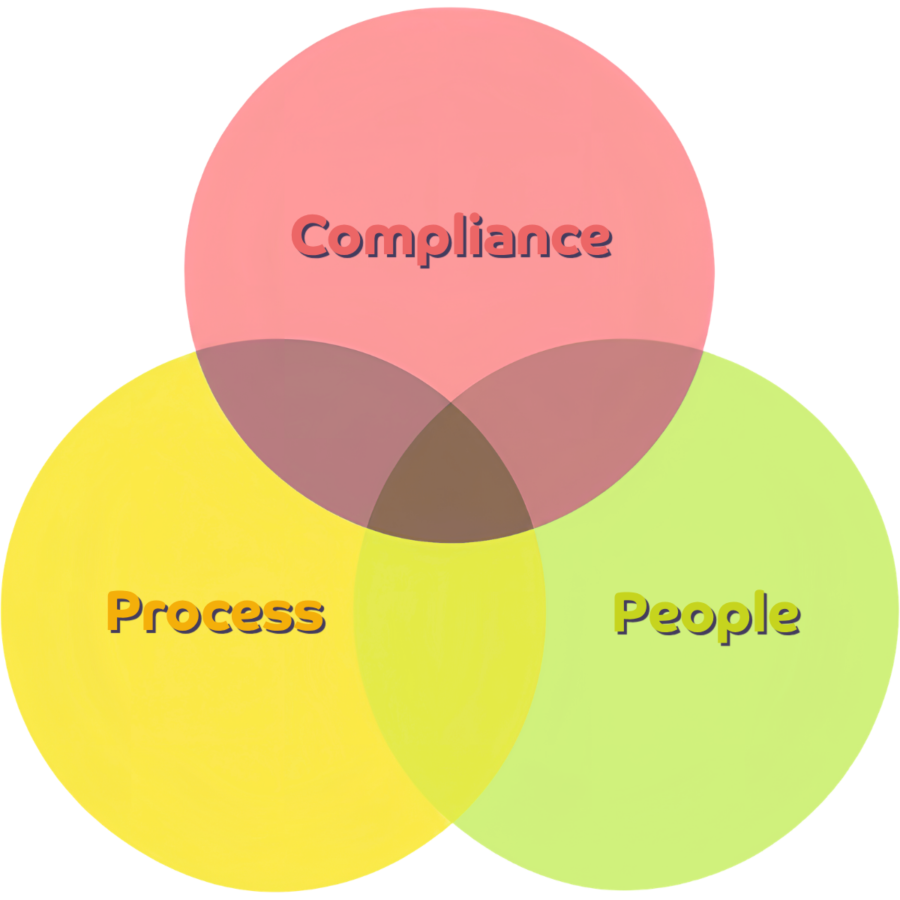
If you are struggling to make Health and Safety work in your organisation, and you keep hitting barriers even though everyone knows it needs to be done, it can help to look at it as 3 parts.
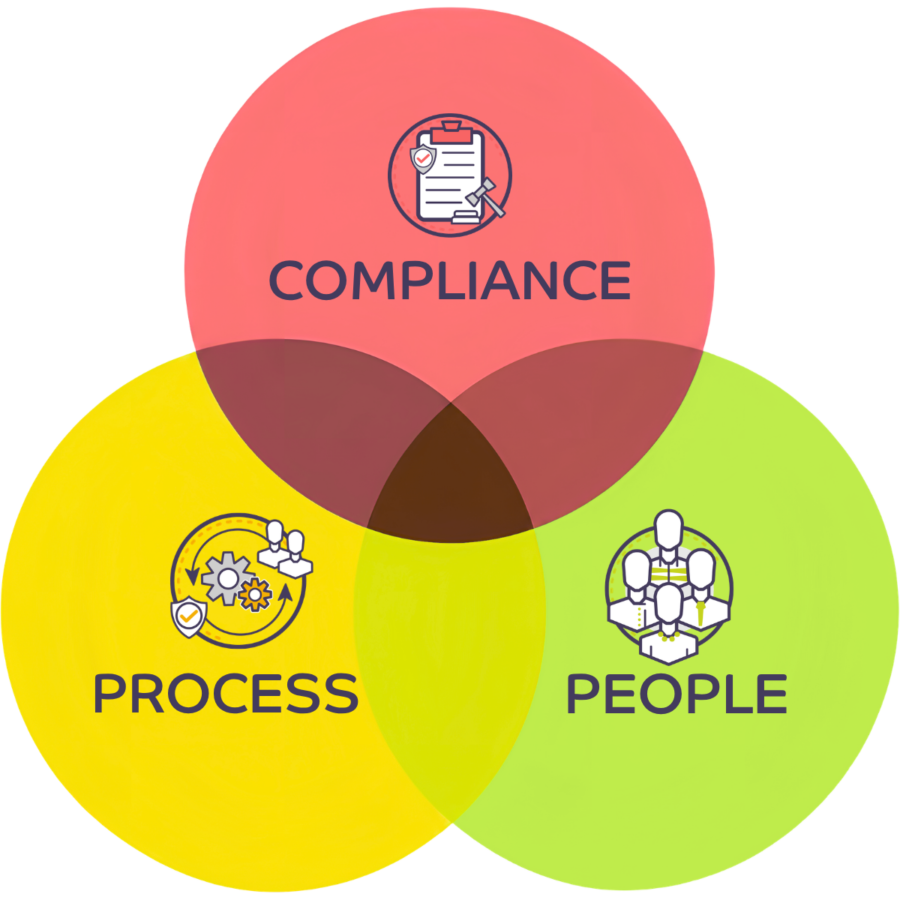
These 3 components have to work together; they underpin one another.
COMPLIANCE – the legislation, regulation, management standard that you need to comply with
PROCESS – the mechanism that makes the above operational, a real-time live process
PEOPLE – the engagement of the organisation’s people, leadership, management and employees.
Compliance has to work for People
Let’s look at how these start to interact, or not.
Perhaps the easiest one to deal with is COMPLIANCE; that is simply the interpretation and application of the relevant legislation, isn’t it? Yes, and no. Let’s look at a Risk Assessment.
A Risk Assessment performs multiple functions; it lets us assess risk and apply appropriate control measures. But its function doesn’t end there, because the Risk Assessment has to be understandable to the PEOPLE. If the Risk Assessment is written in a language that only the safety professional understands, then you won’t get the engagement of PEOPLE – 2 core drivers of employee engagement (According to the Gallup Q12)
1. I know what’s expected of me, and
2. I have the knowledge skills and resources to do it.
(We’ll keep revisiting these).
The same applies to elements of the safety organisation: SOPs, RAMs, and Method Statements.
So we have to view COMPLIANCE through the lens of PEOPLE.
Turning Compliance into Process
But between understanding and operating safety is the PROCESS.
COMPLIANCE that isn’t operational is not providing any protection to the employees or the business.
This is where we need a PROCESS – the mechanism that ensures the ongoing operation, review, and improvement of our safety arrangement: Plan-Do-Check-Act.
But as well as ensuring our safety arrangements are being maintained and operating on an ongoing basis, our PROCESS also needs to embrace our PEOPLE engagement drivers (I know what’s expected of me/I have the knowledge, skills, resources) and a couple of other PEOPLE factors:
1. What’s easy gets done – if the PROCESS is awkward, clunky, it’s less likely to get done
2. What’s measured gets done – if the PROCESS doesn’t provide real-time visibility of what individuals need to do or how they are performing those things, it’s harder to get PEOPLE engagement, which includes accountability.
‘What’s easy gets done ’ can’t be underestimated, and digitisation has much to bring to the table to make PROCESS easy.
If a checklist can be completed easily on an app, providing evidence with a picture of the check completed, and on pressing save, that’s it all done. That’s easier/better than a paper checklist, which is more likely to become a tick-box exercise. If that same “save” also records that the task is complete and, at the same time, produces a performance score that is immediately shown on the Safety Managers dashboard and triggers an alert if the score is below xx, then this is getting easier. QR codes that enable easy access to relevant information or to report a hazard are other enhancements to the PROCESS.
What’s measured gets done
‘What’s measured gets done’ should also be a key deliverable of PROCESS, and this means data, particularly LEAD indicator data.
If this is an unfamiliar term, data is either Lead or Lag Data.
Lag indicator data is a measure of something that has happened – an accident, for instance.
Lead indicator data measures something happening that could give rise to the Lag indicator.
So if the Lag indicator is an accident on a construction site, then the Lead indicators might be that;
- Only 80% of employees were wearing the correct PPE.
- Only 60% had received safety briefings on the relevant method statements.
- Only 50% of plant had up-to-date pre-start inspections, etc.
The Lead indicators tell you there might be a problem and allow you to influence the outcome.
And possibly the purest H&S lead indicator: what % of our control measures are in place, operational and being complied with!
If this Lead data is captured as part of the PROCESS, it provides a performance measure for the organisation and its components. This then feeds back into the PEOPLE component.
From data to leadership and engagement
Leaders frequently struggle to engage in safety because they can’t relate to it. Think about this in the context of a Risk Register. We need a likelihood and Consequence measure. Consequence can be calculated, including the likely fines the organisation can incur (Sentencing Council Guidelines), but what’s the likelihood? Where does that number come from (hint – what % of our control measures are in place, operational and being complied with)? The Likelihood plays a bigger part than is often appreciated. There is a gender bias in risk: the male brain looks at Likelihood first, Consequence second if Likelihood is high. The female brain prioritises Consequence over Likelihood. Male leaders need a Likelihood to engage in the risk and a risk solution. They know they have a legal responsibility, but how do they understand performance “how are we doing?” “How compliant are we?” What is the Likelihood?
The answer is not we have the COMPLIANCE in place. If the PROCESS produces the right data, the Leadership Team can act and make decisions. For example, if we can see we are 95% compliant with our safety arrangements in all locations except X location, we can then tackle X location.
And the Leadership’s understanding of risk will build engagement, which is critical to creating the organisational alignment and accountability – which supports the need to engage in COMPLIANCE.
Making it work across the organisation
This brings us back to PEOPLE, the engagement drivers (I know what’s expected of me/I have the knowledge, skills, resources), and how we start to build alignment across our business for Safety. If people are asked to do something they don’t understand, resistance is natural. Equally, if they feel they are being given responsibility (or liability) they aren’t comfortable with, there will be resistance. And if the PROCESS makes it easy to do, that’s another tick in the box
So, it helps to break the COMPLIANCE/PROCESS down organisationally, as in the diagram below. Everyone knows what’s expected of them, in simple terms. So a Site Manager doesn’t feel like he is the Site Safety Officer, but is responsible for making sure what should happen does, and if there’s a problem, making sure it’s fixed fast.

Bringing it all together
Ultimately, COMPLIANCE, PROCESS and PEOPLE cannot work effectively in isolation. Compliance defines what needs to happen; PROCESS makes it operational, measurable and easier to do; and PEOPLE provide the engagement, leadership and accountability that make it happen in practice.
When these three components work together, Health and Safety moves beyond policies, procedures, and legal requirements. It becomes a living part of how the organisation operates – with clear expectations, effective processes, meaningful data and people who understand their role.
The aim is not simply to demonstrate that we have COMPLIANCE in place. It is to create a system where we can see how well that compliance is operating, where people understand what is expected of them, and where leaders have the information they need to act.
If you found this article useful, you may also be interested in our related insights such as
Register For Academy Session
Free virtual workshops covering Health & Safety and Business Continuity
Download
Download to save, print or share this insight.
Free virtual workshops covering Health & Safety and Business Continuity